By Tony Jones, CEO, One Nucleus - Email: [email protected]
Triggered by advances in technology, geopolitics, and patient expectations, there is no denying that the dynamic landscape of innovation, investment. and integration in the R&D of innovative medicines is changing at a rate not experienced previously. The consequence of rapid change is always the creation of cohorts of winners and losers. Some are entering the game with no preconceptions of how it should work, some will adapt to the new environment to remain competitive, and some will lose their competitive edge. It has long been accepted that success in this field has been driven by collaboration and shared challenges. The need to be collaborative has not diminished. but with the interdisciplinary nature of modern R&D and the increasing global competition. do bio innovation clusters need to align with clarity of identity and purpose to remain in the top tier?
Current Landscape:
The trends in seed venture capital rounds raised by drug discovery companies in the UK over the past decade reflect how challenging an environment those early-stage companies now find themselves enduring. Whilst the cumulative investment raised has shown a recovery from the depths of the late teens, the number of deals is still trending downwards from the highs of 2021. This illustrates what many commentators have described in terms of fewer but larger deals.
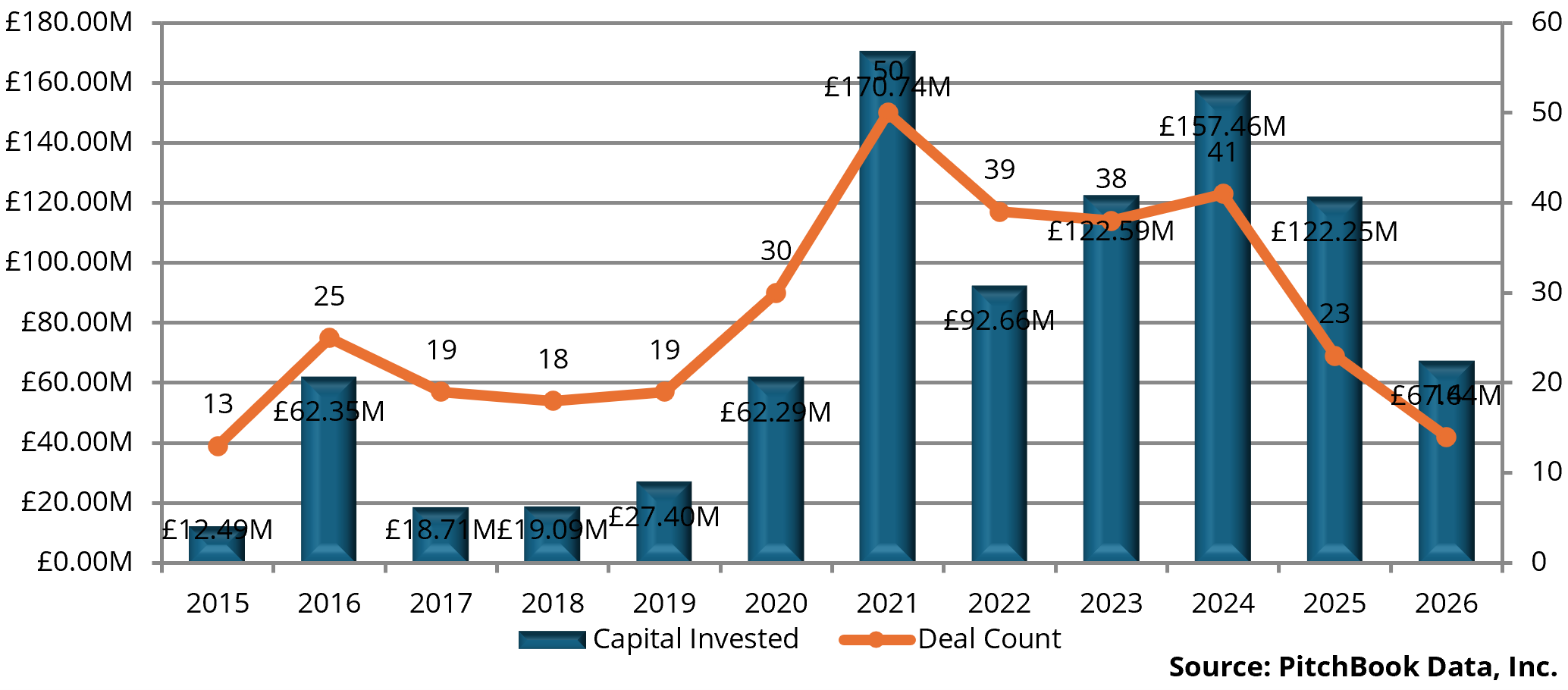
The factors driving this trend are likely manifold and include the costs of capital when interest rates remain stubbornly high, geopolitics, the rise of new innovation hubs bringing greater competition, a shift from investors seeking later-stage assets and more. The emergence of AI/ML in Biopharma R&D can also be considered to be having an impact with numerous recent large deals, both from venture investors [e.g., Isomorphic Labs’ $2.1Bn Series B round] and Pharma [e.g., Lilly – Insilico AI’s $2.75Bn collaboration]. An aspect of the trends we are seeing could be that BioTech investment is down because TechBio investment is up.
Competitiveness Through Being Collaborative
Clear from much of the messaging from investors and R&D partners is that their thoughts are aligned with execution, not just innovation. Ideas are not the rate-limiting step per se, although good ideas that can be commercialised, may be a different matter.
Attracting interest and credibility when seeking investment increasingly seems to revolve around the execution plan as much as the exciting innovation proposed, especially where it is early-stage and there will be gaps in the data package yet available. Adding to a credible plan, a team that has succeeded previously, the odds of generating a signal of investor or corporate partner interest look much improved. Established biotech clusters globally have these ingredients and expertise to meet such criteria, present and accessible. It can be in the nature of leading innovators, however, to be somewhat disruptive and single-minded rather than team players beyond their immediate trusted circle. This leaves the technical and business translation risk at a case-by-case level rather than portfolio level. Collaborating at a cluster level to move beyond case-by-case risk to a portfolio level may provide the means to increase the attractiveness of the region to global innovation capital, hence fuelling a flywheel effect of connectivity, relationships and deal flow. Collaborating as a cluster, resulting in the outcomes being much more than the sum of the individual parts.
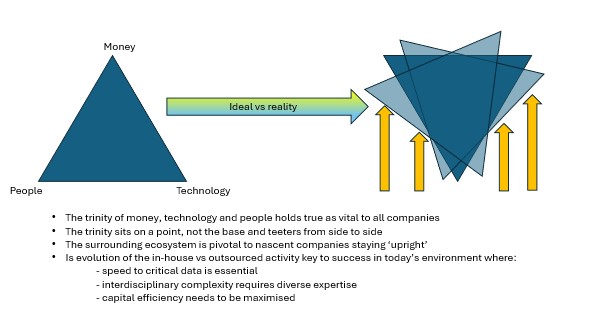
One of the reasons leading clusters such as the Cambridge-London axis are so effective is the landscape of connectivity and support in which companies start, get nurtured and grow. Whilst traditionally we consider the trilogy combination of leading-edge technology, investment and people as the essentials, as illustrated below, that triangle does not sit on its stable base. Rather, it sits on the point and wobbles, being kept upright by the surrounding ecosystem of support. The depth and density of connected experience across the required R&D and business disciplines enable that surrounding support matrix to create and deliver success.
Whilst competitive to date in their field, the competitiveness of established bio-innovation clusters such as the UK and the US is being brought into question as the voracious appetite of e.g., China seeks to eat their lunch. Policy moves to reduce regulatory, investment and commercialisation friction are happening which are undoubtedly aimed at narrowing the better, faster, cheaper challenges posed by Asia. Leading biotech clusters, possessing depth of R&D expertise, entrepreneurial culture, experienced investors, large corporate presence and experienced advisors, now have a golden opportunity to grasp the future, delivering greater capital efficiency, speed and quality outcomes as the global markets for their collective products grow in terms of size and accessibility. The challenge to be competitive, however, must be addressed in order to remain in the game. Perhaps it starts with a clear vision of identity and how deciding what you are at a cluster and individual business level from the outset makes it easier to succeed.
Is there an alternative way to futureproof competitiveness through identity alignment?
Recently I have been intrigued by discussions about company identities with the innovative thinkers at Alignment Cubed (https://alignmentcubed.com/). They have developed an approach to help companies manage complexity, aligning their teams, purpose and vision to maximise effectiveness and competitive advantage. They illustrate their approach as follows:
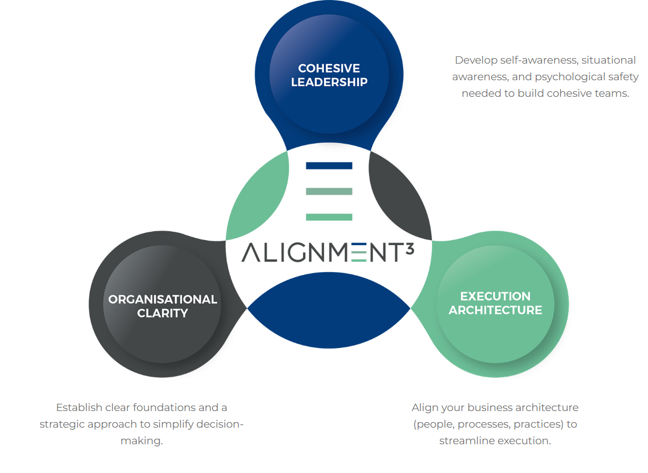
Alignment Cubed considers four well-researched company identities, and I would encourage checking out the brief introductory video to understand this matrix more fully and how it could be applied to any business. I also think that it provides an avenue to consider alignment at a bio-innovation cluster level.
Which identity are you?
For the purposes of my musings here, I have adapted the four identities a little to explore how these identities could interact at a biotech cluster level to deliver on speed, efficiency and quality as we found, grow and exit new biotech businesses.
- The A Team
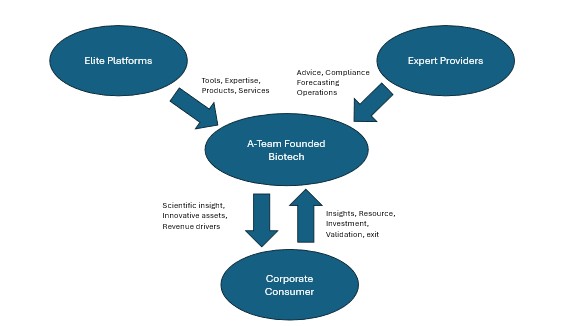
New biotechs are founded by a small team of co-founders – The A Team. The group brings deep expertise in the subject matter, previous venture investment experience (or access to it) and huge passion for the cause. These are essential elements. The vision may be to scale their company as they secure multiple investment rounds, forge partnering deals and progress their product development. They may scale in that way, but does that lead to being an Innovation Platform or a larger A Team?
- Elite Platform
These players surround the acutely focussed A Teams and constantly innovate to bring advanced products, tools and platforms to the R&D space that enable those A Teams to deliver. Elite Platforms are broadly enabling of many programmes in different therapeutic fields and even disciplines. These entities, be they platform, product or service business models, bring deeply specialist offerings and scale with market penetration, are protected by their IP (both hard and soft) and are key R&D partners to the outsourcing or collaborative drug discovery and development companies.
- Corporate Consumer
Sitting at the top of the bio innovation food chain are the Pharma and Large Biotech corporates who, whilst undertaking their own early-stage R&D, are increasingly hungry for external sources of assets to take to market. Highly efficient at scaling development, regulatory navigation and market penetration, these major players accelerate the bench-to-patient journey and ultimately provide the exit route to generate returns for those investing in the A-Teams or Innovative Platforms.
- Expert Provider
Often the more undervalued stakeholder group, these are the service providers that supply the deep technical, compliance, legal, and operational advice on-demand and solutions the above categories all rely on. The key for this group is their specific knowledge and capabilities to be able to provide those services efficiently and to a high quality. Added to these abilities is their global connectivity, often leveraged by others to enter new markets smoothly.
Shape-Shifting and Hybrid Identities
There is nothing that says a company cannot transition between identities as they evolve internally or the market evolves externally. It may be that an initial A Team may become an alternative identity, such as Elite Platform or even Corporate Consumer, in the longer term. Equally, an Elite Platform may elect to develop its own asset pipeline in a specific therapy area, so it behaves as an A Team or hybrid. Nothing is a one-way street, yet the organisation having a strong sense of identity from top to bottom does, as Alignment Cubed explain, lead to a much more efficient and effective decision-making environment given it is a business-wide mission they follow with a sense of purpose.
Driving Competitiveness in a Complex Environment
The rate of change of technology and the interdisciplinary nature of biotech R&D mean drug discovery and development is an internal/external balance of activity. Where the options to acquire the expertise and/or capacity are between buy it, borrow it or grow your own, then the value of strategic outsourcing is evident. Whether through collaboration or fee-for-service contracting, working with expert partners helps maximise access to additional disciplines, speed and capital efficiency - the three key levers of competitiveness.
In such complex and challenging innovation sectors, geography matters. Innovation is a contact sport and is enhanced by direct human interaction, so physical biotech clusters still have a major role to play in the genesis and translation of the next world-changing ideas. As Nelson Mandela famously said, “A vision without action is just a dream. Action without vision just passes the time. Vision with action can change the world.”
The proximity of trusted complementary expertise, advice and services across all the required identities can bring competitiveness, but perhaps only if those clusters are aligned collectively to support the creation and execution of an investible plan. Moreover, those broad categories of identity all have their role to play in developing such a plan as the A Team seeks to move from hypothesis to plan.
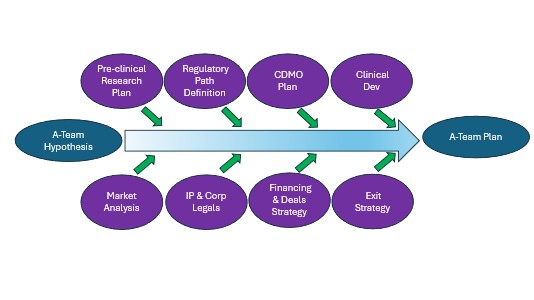
When competing for investment capital, licensing deals, or M&A exits, the Nelson Mandela quote holds true. There has to be a vision for value creation, and that vision must be accompanied by a plan of action that creates change in patient outcomes if it is to move from ideation to invoice. Absolutely, it is rare that the A Team is going to deliver the whole plan much more likely a Corporate Consumer will acquire the de-risked asset along the way. In biotech it is not easy to plan so far ahead at ideation. This is where the strong relationships, breadth of expertise and collective track record can enable leading clusters to differentiate in creating success. To truly harness that competitive advantage for its constituents, however, creating alignment where goals and roles of each player are known may be key.
Embracing Identity Diversity to Supercharge Growth
Returning to how that trinity of ‘Technology-People-Money’ is essential for an A Team to succeed and how being supported not to topple over by the right surroundings is key. It is not too much of a leap to envisage how the right blend of identities in a cluster could be coordinated to maximise the collective competitiveness. Ecosystem activators and developers seeking to facilitate scale-up, job creation, lab occupancy and so on, need to facilitate a different approach. As opposed to concentrating on scaling the headcount in A Team companies, often moving them away from their core competitive advantage, scaling the support system of Elite Platforms and Expert Providers to protect and nurture multiple A Teams could achieve a number of goals. These may include greater economic resilience of the cluster, scaling of Elite Platforms, Expert Provider employment and attraction of investor and Corporate Consumer presence seeking early positions on leading, de-risked innovation assets. secure investment that is deployed.
Attracting the World of Bio Innovation:
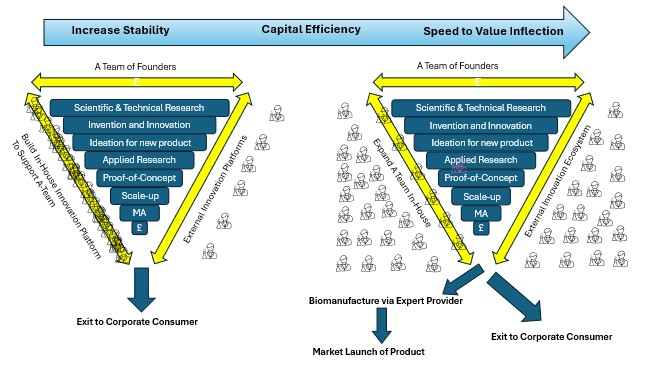
Focussing on enabling A Teams to partly be in-house to refine the hypothesis and recruit the A Team colleagues they need whilst creating conditions that scale the external innovation ecosystem leads potentially to a different shape and dynamic of a cluster. Provision of such an environment creates not only a de-risking, capital-efficient and competitive ecosystem for those A Teams arising locally, but also a welcoming landing environment for distant A Teams to locate within to maximise their own probability of success. Fuelling this idea pipeline, such an alignment also facilitates the growth of the surrounding Elite Platforms and Expert Advisers through new and repeat business alongside reputational growth and market penetration elsewhere. Delivery of an attractive asset pipeline will in turn attract innovation capital investment and Corporate Consumers seeking streamlined access to high-quality deals that come best from being in situ and building strong personal relationships.
The remaining question
Geopolitics and the deployment of long-term strategic plans developed by regional and national governments to harness the growing knowledge economy have thrown down the gauntlet to the traditional clusters. How the old school responds remains to be seen. It truly feels that the future is aligned, collaborative, and specialist at scale for any cluster to be competitive globally. Perhaps the remaining question for any cluster will be whether there is the collective will to align in ways that can deliver that competitiveness.
One Nucleus
One Nucleus membership has always been diverse by design. Bringing the range of skills, insight and passions together under one metaphorical roof leaves our community best placed to tackle change in an effective and informed way. Supporting our members through three main streams of insight and connectivity; accessing investment and deal-making environments; and operational support as their businesses grow provides us with a sense of purpose aligned with that of our members. Learn more about One Nucleus at www.onenucleus.com.