The future of biotech fundraising may not belong to companies that pitch to the most investors. It will more likely belong to those that understand which investors are most likely to become long-term partners and how to navigate to them efficiently. In fundraising, as in medicine, precision is beating trial and error.
Tony Jones, CEO, One Nucleus, Email: [email protected]
Topics in this article include:
-
Sector sentiment update
-
Investing in precision
-
Spray & pray vs targeted fundraising
-
Leveraging AI and technology
-
Balancing cost and benefit of platforms and conferences
-
One Nucleus support matrix to help
With in excess of 5,000 investors doing deals in drug discovery alone worldwide in the past two years as the capital pools are becoming increasingly global and connected, the two-century-old adage that one has to kiss a lot of frogs to find the prince has perhaps never felt more relevant than to biotech companies raising equity investment at the current time. There is a good degree of optimism in the biotech sector as a whole that deals are happening, investment flows are increasing, and it may only be a matter of time before early-stage discovery and research opportunities come back into vogue.
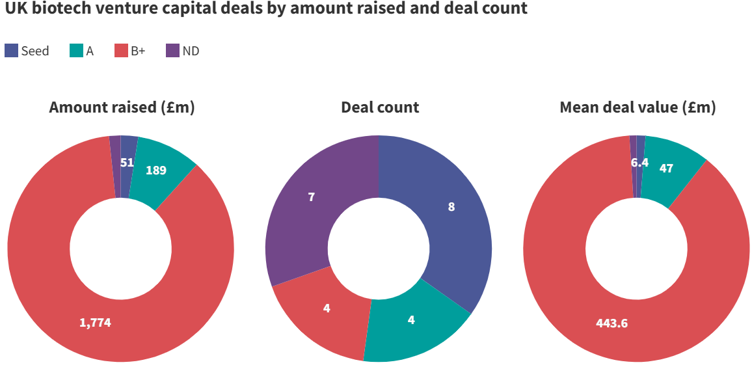
The recent BIA UK Biotech Financing Report indicates a continuing upturn with investment at all stages, as illustrated in the figure from that report below. The data is heavily skewed by some mega headline deals, though, so perhaps underneath the headlines the trend lines are less convincing, especially for those in the earlier stages. It is evident that the more buoyant headline investment totals are not translating to R&D job creation in the UK, and it is also clear that the gap between the haves and the have-nots remains wide when it comes to securing investment. So, the search by many entrepreneurs, founders and biotech leaders goes on!
Investing in Precision Drug Discovery
PitchBook data since 2015 would suggest that investors are increasingly liking the trend towards drug discovery with precision at its core. In the UK alone, Myricx Bio has extenuated the trend, but the underlying trend excluding that deal appears strong. The approach is enabled by advances in technology, use of AI and greater understanding of disease pathologies, along with M&A partners willing to pay high premiums.
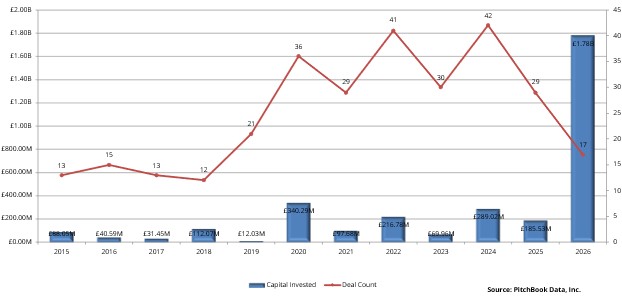
Many commentaries have suggested this later-stage deal focus is driven by several factors, such as geopolitics, to cost of capital and pending patent cliffs. These factors are for sure all important, yet preclinical investment and M&A deals are being reported. These have included the recent $1.4Bn acquisition of Myricx Bio by Novartis and TRIMTECH Therapeutics’ $47M venture raise. So, why are some securing investment while others not?
There could be a feeling that the teams securing early-stage investment have better connections, stronger track records or even a better sales patter. There is perhaps no single reason, since whilst having world-class innovation led by a well-connected and experienced team is not always sufficient now. A company can do everything under its control right, and it still needs to be lucky sometimes to be in the right place at the right time when the rate-limiting step is investor or corporate partner attention rather than innovation supply. The competition is fierce.
Why Does Fundraising Feel Like Kissing Frogs?
In a drug discovery world that is delivering medicines with greater precision in terms of molecular target engagement, drug delivery, and patient selection, there is still a feeling that the search for an investor remains a bit like a spray and pray approach, having cast the net wide when it comes to pitching to investors. Biotech leadership teams routinely hold dozens, if not hundreds, of investor meetings; seek endless introductions by mixing at the right events; try hard to move beyond a generic pitch deck to resonate with each investor met while still retaining the passion and enthusiasm for their value proposition that is essential to connect with an investor on a human level. It can feel like a tough endeavour where it feels like months of effort resulting in little progress. And all the time, the cash runway is shortening, and a deal is increasingly pressing.
What if the Problem is Not the Science, the Team or the Slide Deck, but the Targeting?
In a fireside chat with Simone Fishburn of BioCentury 2024, E Eric Tokat of Centerview Partners remarked that ‘assets in our sector are always bought, not sold’. A reminder that Pharma acquiring an asset they want is rarely a deal broken by cost but more likely a deal broken by the asset not being a fit for their strategy and pipeline. There is no compelling reason why investors do not behave likewise. There may be more flexibility and opportunism, but essentially there are clear criteria investors seek out. Investment-seeking biotechs are pitching a vision of what could be rather than a ready-made asset. Capital will need to be spent, and risk will need to be taken before any return on investment can be realised. After all, the likely exit route will be M&A, and hence the envisioned product will be subject to the same Pharma scrutiny ultimately, so the potential fit is important.
Investors will be driven by their specific mandates from their LPs on top of needing to see a fit with corporate M&A partners after value inflection or even a clear route to market if planning to stay independent until IPO. Specifics such as therapeutic vs diagnostic; therapeutic area, geography, ticket size, and portfolio conflicts can all determine the level of relevance of the opportunity. There are innumerable reasons a biotech could be pitching to the wrong investor. That said, the wrong investor is not a bad investor; they are simply the wrong fit.
Following the Four R’s of Precision Fundraising
Drawing the parallel to precision medicine, which is moving away from treating every patient and instead treating the right patient with the right medicine in the right tissue at the right time, then a more precise approach to fundraising could be interpreted as targeting the right investor with the right opportunity at the right time with the right message.
In precision medicine R&D, the latest technologies generating a depth of data and leveraging AI mean some the R’s are addressed in the process. The ever-growing amounts of data on investors, often curated by commercial business intelligence providers for ease of use, mean biotechs can leverage technology, including AI, to help address the R’s of precision fundraising. It has possibly never been easier to build (or acquire) a comprehensive list of investors, their profiles, their activity to date, and contacts. Of the global pool, there will be the right investor/s for any quality opportunity; the challenge becomes in finding the right frog to kiss. Biotech leaders, much like every other business leader seeking a customer, partner or investor, start with defining the ideal target. Investors are prioritised by their foci in investment stage, therapeutic area, technology platform, geography, typical ticket size, whether a lead or follow investor, track record and their syndicate preferences. When the starting list may be hundreds, perhaps even thousands, of investment sources, prioritising can be overwhelming for any entrepreneur.
Fortunately, as much as investors now have the benefit of tools such as AI to track and identify leads of interest, biotech leaders have the mirror tools available to identify and interrogate investors in order to target their efforts. Subscription databases such as Beauhurst, Biotechgate, Life Science Nation, PitchBook and more undertake a huge amount of primary research and data collation to enable those seeking capital to prioritise investors with the best fit as well as those with capital available to invest in the right opportunities. This is complemented by the less formal sources of information and connectivity through previous companies, the existing investors and so on.
From Target Identification to Lead Generation and Outcome
In the way that applying the latest advances in technologies, including -omics, AI, functional genomics and screening, can enable scientists to identify and validate a novel drug target, there is a wealth of supporting data sources in the literature and in other groups to help. Addressing questions like which molecular pathway is being affected, what side effects may be expected, how can the target be engaged and so on enables the R&D scientist to progress testing of their hypothesis for an innovative medicine.
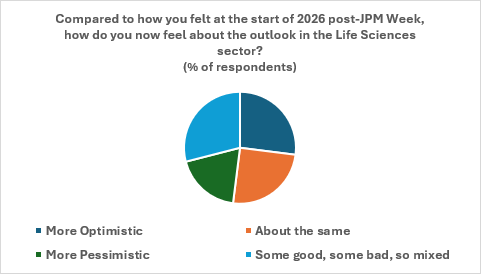
For those seeking to identify and target the right investors, similar principles apply. The depth of available data and connectivity allows for prioritising as above; the biotech leader hypothesises which investors should be approached and works on a strategy to engage them. Everyone has the ability to call or email the investor to make contact yet based on a poll run for One Nucleus in 2025, the data suggested cold calling was perhaps not the optimal approach. As illustrated below, cold calling felt like a fairly inefficient mechanism compared to warm introductions or event conferences when it came to direct lead generation.
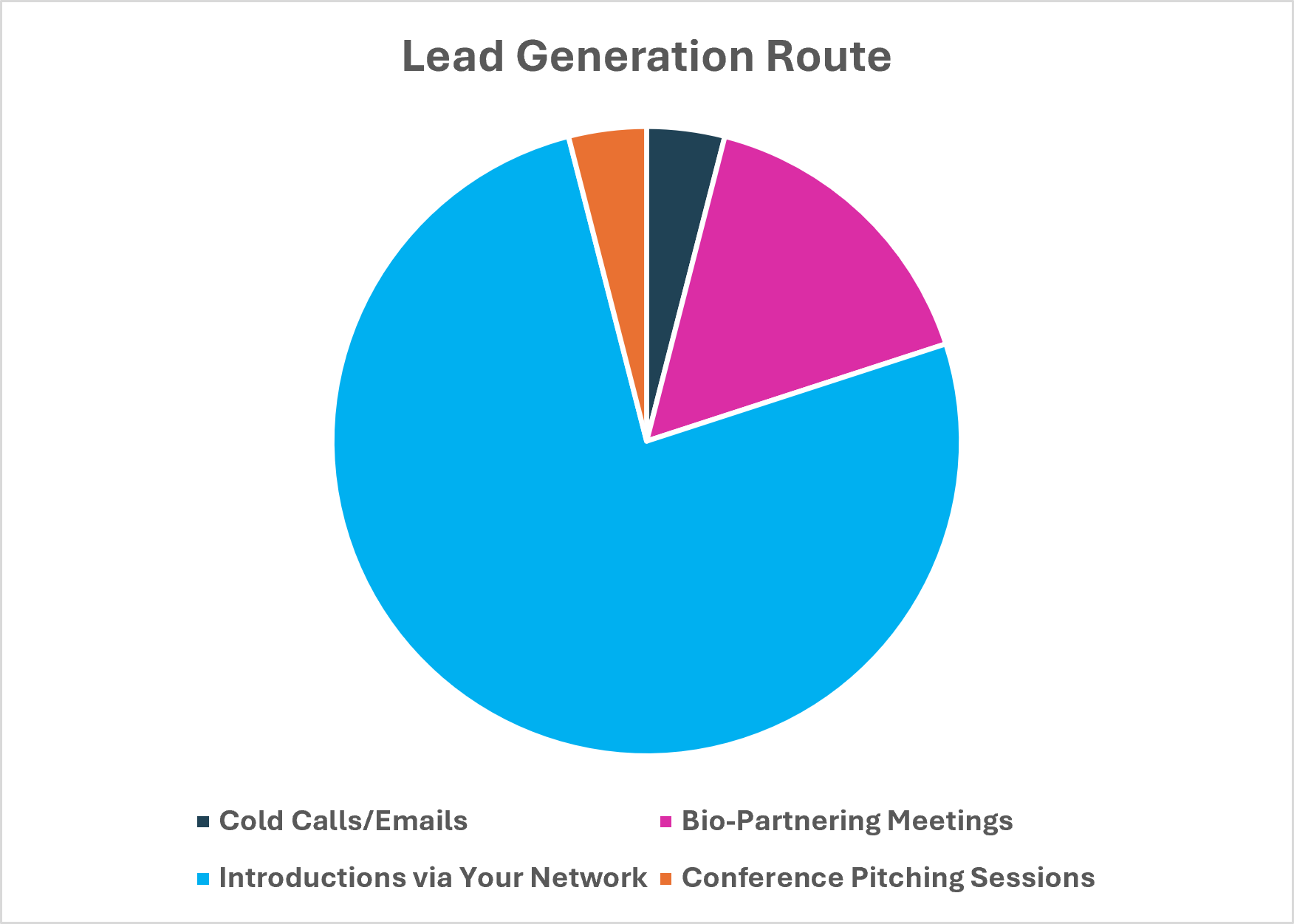
Much like the R&D scientist, perhaps engaging the target investors is a case of pathway mapping, networks and introductions. Identifying an investor that meets the criteria of mandate and status listed above, it is then possible to map out that investor’s pathway of activity and their connectivity based on their activity to date. Who they have invested in already does not only illustrate their preference of opportunity but also which founders and biotech leaders they have shared success with. Moreover, looking wider than the teams they have invested in, it reveals who they invested with, sat on boards with and sought advice from. These direct contacts are likely to be the executives and reference points they trust the most. The question for the entrepreneur is whether they, or someone they know, sits among that investor’s trusted network. The results of another One Nucleus poll conducted around the same time as the one above illustrated this point. When asked about the hardest step in closing a deal, it was often not the price or the technology; it was the human factors of the need to build rapport with the buyer, gaining the trust of the buyer’s advisors and having sufficient brand value in the sector.
Help!
Profiling investors, mapping their connectivity, and building brand value are all commendable activities for a biotech seeking investment to afford a precision approach to fundraising. Clearly prioritised investor lists, warm introductions and tailored pitches all increase the speed and chances of success of a fundraising campaign. But there is a downside that can be a critical barrier. That is of course, cost and resources. First, much of the data on investors, especially those outside of the biotech region, are most efficiently accessed through commercial subscription-based platforms. These can be very expensive and unaffordable on a limited cash runway. Second, the ability to develop one’s network of contacts to gain warm introductions is often seen as a reason to attend large investor conferences, which again can be costly in both cash and time for the management team. Building brand value in the sector and gaining trust, are maybe less well-defined activities than direct connectivity and data access, yet they can also be cash and resource intensive. This is by no means to say attending large conferences is a bad thing at all, but as for any event, it is usually worth considering why the other attendees are there. This could be to scan for new opportunities, but equally it could be to scan for threats to their portfolio, seek opportunities for their existing portfolio or simply to meet with their peers to discuss key industry trends. The question becomes one of cost/benefit ratio across all these things. There is no harm in asking organisers and providers for justifications such as references and data to back up their claims in the way such due diligence is performed on other outsourcing procurements.
Shaping the One Nucleus Strategy
One Nucleus is always mindful of our remit as a not-for-profit membership group charged with bringing the maximum support we can to members whilst adding the minimum overhead to deliver that support. Recognising the challenges above has been the reason for several of the One Nucleus activities to date, including:
-
Subscription to PitchBook as a comprehensive database of investor activity, profiles and contacts. Intelligence we are able to share with member companies looking to identify their priority targets and map their connectivity to engage them through warm introductions.
-
Increased engagement with global investor and partnering conference organisers to secure the best discount and profiling opportunities for our members possible where they elect to take the leap and resource attendance.
-
Increased inclusion of company pitching sessions at our own One Nucleus conferences and events. This aimed at helping companies build their brand value, refine their pitch delivery and raise their visibility with our whole ecosystem. The trusted advisors to investors and introduction routes are often in the service sector elements of any innovation cluster who should be overlooked at your peril as a valuable set of connections and experts.
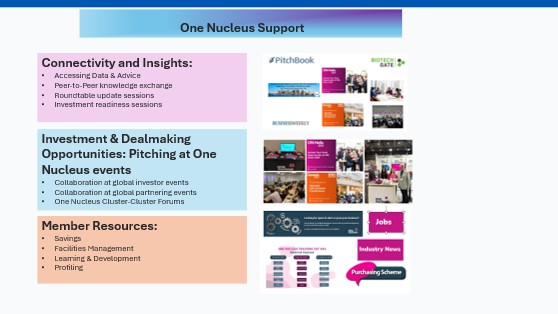
The One Nucleus member support matrix can be illustrated as below. The environment being nurtured is one to create a home of champions. Each member being aware of their counterparts, each willing to share the expert advice and, importantly, each willing to onwards refer and connect another member to those all-important investors, partners and customers they feel would benefit from such an introduction. This is far beyond a simple network; it is a community based on the one collective driver to see great science and innovation improving the lives of patients. Time and again, trusted relationships are highlighted as the key to deal flow and the activity of selling in biotech having very little to do with sales and everything to do with relationships.
Conclusions
-
As raising investment becomes increasingly global, a precision approach to fundraising can increase speed and probability of success
-
Balance cost vs benefit when evaluating the cash and resource requirements of attending
-
Utilise the support offered by a membership group such as One Nucleus to access the resources and connectivity mapping to maximise targeting
-
Be human. Deals happen between people. Take the time to build trust, brand value and mutual respect.
If you would like to be a part of the One Nucleus membership and take advantage of the support available to maximise efficiency, mitigate risk and navigate your journey, please contact us at [email protected]