From a first step into biotech cluster networking in 2000 my time involved with LBN and One Nucleus has provided me a source of many learnings about changes in myself, the members we support and the London biotech cluster generally.
Tony Jones, CEO, One Nucleus
Email: [email protected]
Topics in this article include:
- My membership group and London biotech timeline
- Early days of LBN
- One Nucleus and the London-Cambridge biotech axis
- London’s deal making growth
- Event evolution
- Lessons I have learned
Prompted to reflect
Philippa Clark’s recent blog entitled “What One Year at One Nucleus Has Taught Me About London's Life Sciences Ecosystem” provoked me to reminisce over time I have spent as a founding Steering Group member of the London Biotechnology Network (LBN), my time as LBN Director, the acquisition by ERBI to form One Nucleus and the London dynamic being experienced by Philippa today. Much has changed over the past quarter of a century, and my learning continues as I interact with longstanding friends and contacts as well as gain insights about how the next generation of entrepreneurs and businesses seeks to interact with membership groups and their peers.
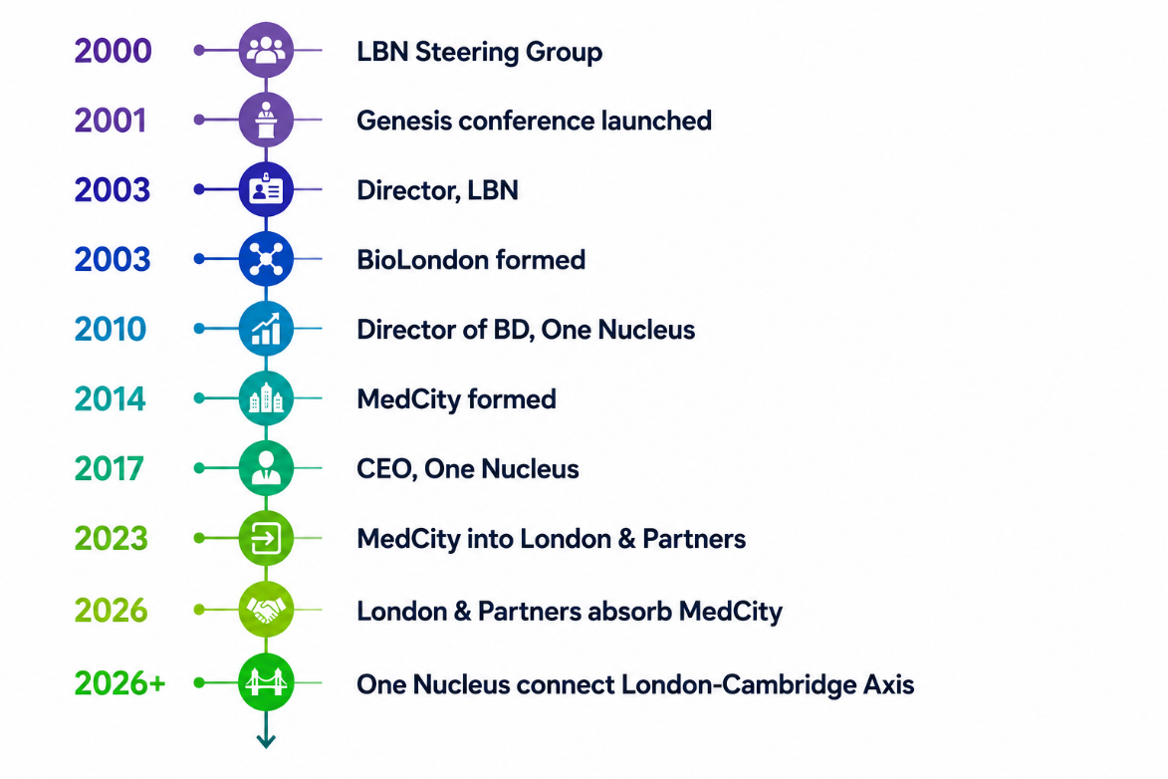
My Membership Group Journey
Where it All Began
The Lord Sainsbury report entitled ‘High Technology: Biotechnology Clusters’ in the late 1990’s was one of a number of reasons regionally based biotech organisations were created to support the ability of academia, hospitals, entrepreneurs, companies and investors to connect. Most were initially funded by the government via the Regional Development Agencies. London was not afforded such public funding, so a group passionate about the sector in London, led by Simon Tarpey and London First (now BusinessLDN) formed the London Biotechnology Network (LBN) which launched at a House of Commons Reception in June 2000. Being a World City, the London biotech cluster had a much noisier backdrop than most to gain attention. Largely known for its tourism, film premiers, Beefeaters, Houses of Parliament, Big Ben, red buses, royal palaces and global financial sector, most generalists overlooked London’s significant science and technology universities and institutions.
Bringing London’s Biotech Cluster Together
When the initial sector mapping took place, 49 biotech companies were identified in London in 2000. There may have been more that could have fallen under the broader definition of Life Sciences Sector now used, though spinouts in areas such as MedTech and HealthTech were far less common back then. Most were at the early stages of learning how to write a business plan, pitch to venture capitalists and operate a business. There was a genuine spirit of collaboration and sharing with much to be gained from assembling the people driving this development on a regular basis. The regular meeting place became the BioWednesdays that launched in October 2000, the annual Genesis conference first held in December 2001. In terms of the public sector eventually joining the efforts, the London Development Agency (LDA) created BioLondon in 2003 as a vehicle to promote London to the world, develop strategies for lab space and support skills development. The closure of the LDA when the Mayoral Greater London Authority came into existence saw the demise of BioLondon. It was several years before London’s political leaders revisited the cycle, launching MedCity in 2014. Political will and actions can be sporadic, and MedCity’s relocation into London & Partners in 2023 further evolved its core mission.
The Formation of One Nucleus – A London-Cambridge Connection
Growth, development and evolution of the biotech industry globally were happening at pace. London’s cluster had perhaps changed more than most. As the biotech innovation sector became more internationally connected, parochialism would be a hindrance. A combined Cambridge – London cluster being more than just additive in the eyes of many international partners and investors, in May 2010, One Nucleus was born out of the acquisition by Cambridge-based ERBI of LBN.
From a personal perspective, the career move, from leading LBN to leading business development at One Nucleus, was questioned by many trusted colleagues and LBN supporters I had come to rely on. From my lens, however, it felt the right thing to do for the companies I was keen to support, and the last thing I wanted to get in the way of doing the right thing for members was my ego at not being CEO. The benefits far outweighed the perceived demotion, as it were. One great benefit as Director of Business development was that I got to influence how connectivity between the two cohorts of members could be nurtured and promoted. There was one striking observation for me, being that whilst Cambridge behaved like a cluster, London behaved like a network.
A Changing London Scene
As much as the connectivity, infrastructure, knowledge and investment patterns have developed at pace, today is seeing the greatest pace of change ever in terms of technology convergence, geopolitics and investment trends. With nearly a million square feet of lab space built and a further 2.7 million under active construction, the growth of entrepreneurial appetite among graduates and innumerable entrepreneurial courses, start-up accelerators, grants and networks, London is better placed than many to create value. Ultimately, success will be assessed on that value creation, be that investor returns, economic development or. most importantly, better treatments for patients delivered. For such success to be delivered requires deal flow and investment, an area in which London has grown immensely with annual deal volumes doubling since 2015.

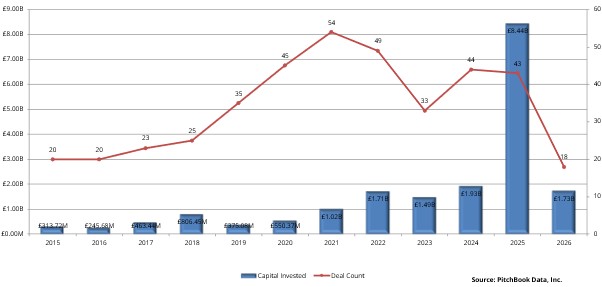
Returning to the earlier point about the broader sector definition of Life Sciences, then even greater growth in deal volumes has been achieved, illustrating London’s strengths in a convergent technology world.
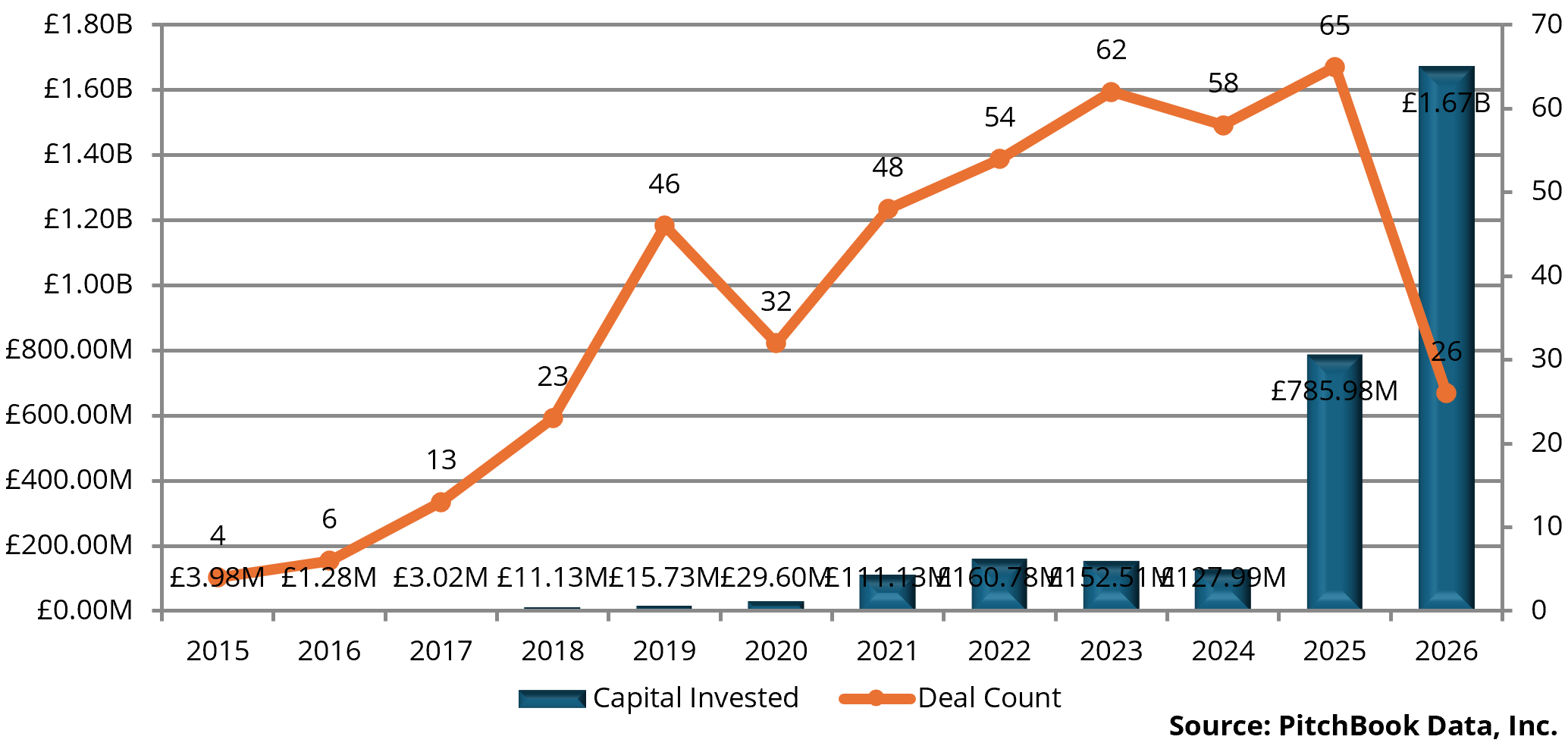
The convergence of tech and biotech, inspiringly now often referred to as TechBio, emphasises the impact the rate of technological change in areas such as AI/ML adoption into bio-innovation is having. If one looks at investment deals where AI/ML is key, the picture shows a dramatic trend upwards in terms of deal volume and investment quantum, especially over recent years. as can be seen below.

Looking Ahead
Some may feel it was accurate future-gazing, some may feel it was astute strategy ahead of the curve and some may feel it was luck, but whatever the reasons, merging to form One Nucleus has aligned fully with how Cambridge and London are increasingly connected, growing and impacting biotech in a significant way. Given the nature of public sector support direction changes such as those detailed above, One Nucleus, initially via ERBI and LBN, has been the constant supporting biotech across the London-Cambridge region. With increased presence in London following the recruitment of Philippa Clark as Director of Business Development in July 2025, One Nucleus stands alone as the most aligned industry membership group for this globally important area of the UK’s biotech sector.
The Changing Nature of Engagement
A recurring lesson learned is that the core to success for any business sector is the people, how they connect, share ideas, develop relationships and execute deals. Enabling this was the very essence of BioWednesdays and to this day the One Nucleus focus is always to provide three key outcomes for delegates to take away from any of our events:
- Key insights and understanding gained
- New contacts made who may at some stage translate to new business activity
- Food for thought on the way home whilst the delegate considers where their new insights and contacts may fit in their strategy
From those early days of BioWednesdays, when everyone was doing things for the first time and opportunities to meet up were slim, it was very difficult not to achieve the three criteria above at an event like a BioWednesday. Nowadays, much more diverse levels of experience or knowledge, innumerable opportunities to meet and changing attitudes to learning and development mean events need to adapt, and everyone should not settle for simply turning the handle if true value is to be gained.
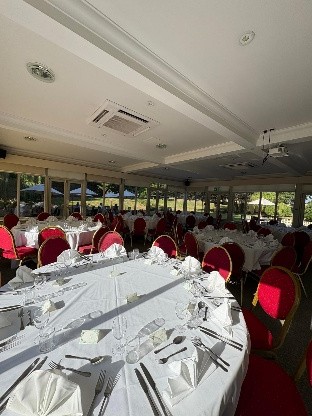
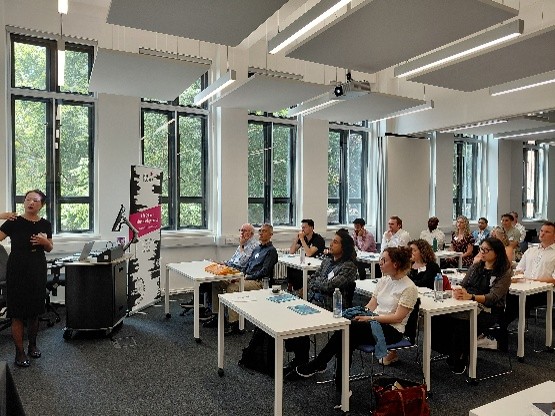
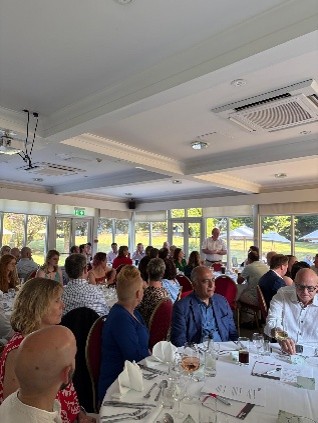
One Nucleus keeps evolving their forums, therefore. Examples delivered recently have included One Nucleus Knowledge Gap Seminars aimed at discussing trends and best practice by topic and the Working Dinners, where up to 60 diners are set a question per course to discuss and report back for subsequent write-ups and calls to action. Absolutely, the value of networking time around the core of any of these events is not forgotten in the planning. Likewise, the evolution of Genesis, ON Helix, BioBeat and the ON Annual Awards is firmly focussed on how to maximise the return on an attendee’s investment to engage. For more details on Genesis, the ON Annual Awards and upcoming smaller One Nucleus Events, do bookmark these hyperlinks check back regularly.
In conclusion
Reflecting on my LBN/One Nucleus journey to date has taught me many things to take on board as I look ahead, including:
- The power of people and their being connected and trusting of each other is paramount to thriving biotech ecosystems.
- Knowledge-sharing and connectivity mechanisms change with sector maturity and societal preferences.
- Personal or group egos can be the largest barriers to progress.
- When planning events, focus on delivering the three main outcomes delegates should aim to take away.
- Be open and generous whilst never under-estimating or taking for granted the support of others and their individual value.
- When you feel really well networked, never forget you only know who you know, and you may not be as connected as you think.